
Executive Summary
PROPOSITION 2 1/2 is a bedrock part of the yearly budget cycle for Massachusetts municipalities. Because it limits the amount of property tax revenues that communities can collect, it restrains how much money these municipalities can spend each year. Although the limits on property tax collection grow slowly every year, cities and towns across the state can override them through voting and new development. Worcester: Auburn, Boylston, Grafton, Holden, Leicester, Millbury, Paxton, Shrewsbury, and West Boylston. Each of these communities has had its own unique experience with the constraints of Proposition 2 1/2. This report looks at financial decision-making between FY2014 and FY2024 in the towns that neighbor In the following pages, readers will learn about the governance structure in these communities, changes in revenues and expenditures over ten years, an in-depth examination of votes to increase the property tax levy limit, and information on new construction, as well as a look into the future of the region.
PAGES 3-5 | DISCUSS TOWN GOVERNANCE STRUCTURES:
- 292 communities in Massachusetts are governed by “Town Meeting” forms of government. Town Meeting serves as the legislative body, and refers to the event where the group convenes.
- Open Town Meeting allows every resident voter to attend and participate; Representative Town Meeting elects residents from precincts.
- Relatively small numbers of people attend Town Meeting each year. There is no statewide mandate for an acceptable quorum for a Meeting to be valid.
PAGES 6-12 | DISCUSSES THE LIMITS ON PROPERTY TAX REVENUE:
- Proposition 2 1/2, adopted by the majority of Massachusetts voters in 1980, limits the amount of property tax revenue that municipalities can collect each year, and prescribes how that limit grows. Since Massachusetts’ municipalities must have balanced budgets, communities are limited by the law on what they can spend each year.
- Communities can levy property tax up to their “levy limit” and are free to increase or decrease tax rates as much as they want under that limit.
- The nine towns under study have seen their general fund revenues and expenditures increase in aggregate by 15.81% and 13.9% (in FY23$) between FY14 and FY23.
- Between FY14 and FY24 (in FY23$) property tax revenues are also up in all nine communities (28.32%) is but state aid revenues are down (-7.7%). Most state aid earmarked for education as part of Massachusetts Ch. 70 funding program — and three of these communities, as members of regional school districts, receive little state aid as a result.
- For the most part, these nine communities levy very close to the limit each year, with little “excess capacity” left over.
PAGES 13-24 | EXAMINES OVERCOMING THE PROPERTY TAX CAP THROUGH VOTING AND NEW GROWTH:
- Communities can overcome the limits on property tax collection through voting or new development.
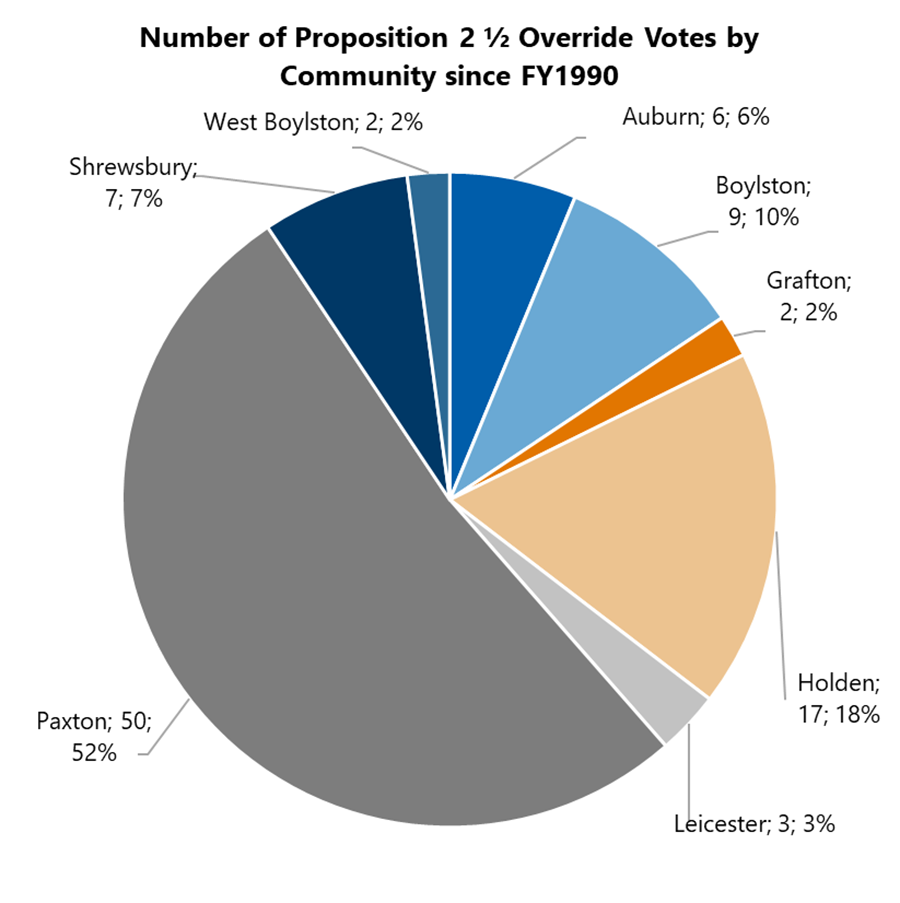
- Since FY1990, these nine towns have had 96 permanent override votes, 118 debt exclusion votes, and 12 capital exclusion votes. These pages show voting patterns, types of votes, and vote margins.
- Many of these votes have succeeded or failed by small margins, usually less than 500 votes, and sometimes by fewer than 100.
- New Growth (i.e., new development) can also increase the limits on property tax. Since 2015, most new growth has been residential, but in recent years, commercial and industrial new growth has come close in value.
PAGES 24-26 | QUESTIONS TO CONSIDER AND CONCLUSIONS:
- Political decisions in these communities are often made by small numbers of people, and property tax limits are difficult in years where inflation expands normal expenditures.
- To avoid future budget crunch, these communities must embrace expansive new growth to increase their limits, and cannot count on community members to vote on Proposition 2 1/2 overrides.

