
Executive Summary
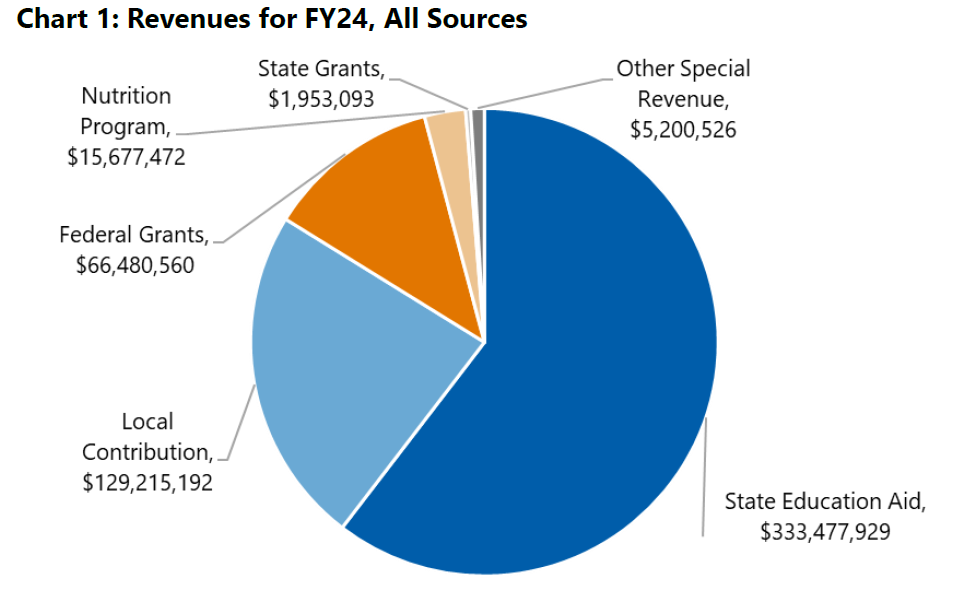
THE WORCESTER PUBLIC SCHOOLS’ adopted budget for FY24, From Here, Anywhere…Together! (including general and special revenue) of $552,004,772 is a 5.4% increase from the adopted budget of FY23. This report, a follow-up to last year’s Investing in Excellence will examine the budget-making process of the Worcester Public Schools, and analyze some of the new additions to this coming year’s adopted budget. This report should be seen as an extension of The Research Bureau’s annual Breaking Down the Budget — rather than give the Worcester Public Schools a section of that report, this will serve as a separate, more comprehensive, and The report begins with an overview of the budgetary process and description of this year’s revenues, including an explanation of the Foundation Budget process and the City’s role in education funding. Then, it examines expenditures, new initiatives, and the use of Student Opportunity Act and ESSER funds this year. Finally, the report compares Worcester, Gateway Cities, and Worcester’s neighbors on required local contributions and net school spending, and considers budget developments to watch in the coming years.
PAGES 3-7 | THE PROCESS BY WHICH BUDGETS ARE MADE AND THIS YEAR’S REVENUE SOURCES
- The creation of the yearly school budget is a months long process that starts in earnest in January with the release of the Governor’s Budget proposal and the initial Foundation Budget calculation.
- This year’s revenues and expenditures of the Worcester Public Schools are their highest ever, $552,004,772, thanks in part to the final use of ESSER funds, and the third year of Student Opportunity Act funds, that serve to raise the Foundation Budget year over-year until level in 2027.
PAGES 8-10 | EXPENDITURES IN THIS YEAR’S BUDGET
- Worcester Public Schools’ largest expenditures are in salaries and benefits of its employees.
- There are 5,376 employees budgeted for more than 24,000 students. Of this, 2,703 are teachers and 699 are instructional assistants.
- There are 228 more employees in FY24 than in FY23, which includes teachers (75), transportation (49) and instructional assistants (25). Twelve are district administrators and six are school administrators.
- WPS continues to fund new initiatives, like its Spark Academy at Wawecus Road School, and to fund the Student Opportunity Act initiatives initially detailed in its 2020 SOA implementation Plan.
- Worcester has budgeted $14.23 million for facilities and capital improvements, including renovations, maintenance, and other repairs across a variety of its schools.
- In FY24, the City will continue the construction of Doherty Memorial High School, slated to open in August 2024.
PAGES 11-13 | COMPARISONS, WHAT TO WATCH, AND CONCLUSION
- This section compares Worcester, Gateway Cities, and Worcester’s neighbors on required local contributions, state aid, and money spent in excess of the required net school spending.
- Required local contributions are based on property wealth and total community income, so communities with higher values are required to contribute more as a percentage of their Foundation Budgets. Communities with more students, and especially more low-income students have higher Foundation Budgets.
- A number of developments to watch in the coming years:
- Next year, there will be no more ESSER funds to spend.
- A statement of interest to the Massachusetts School Building Authority has been submitted to replace Burncoat High School. If approved, it is estimated to cost at least $500 million in total.
- Worcester is a 1:1 Chromebook district, and it will need to replace these in the future.
- New Student Opportunity Act funds continue to come online.
- A new WPS strategic plan is under development.

