We invite you to suggest a research topic for us to consider

The Research Bureau receives many suggestions for report subjects. When considering the viability of a potential report, WRRB staff asks a series of questions. In an effort to ensure we have answers to these questions when discussing an idea or pitch, we ask that our friends and partners with ideas provide as much detail as possible when submitting.
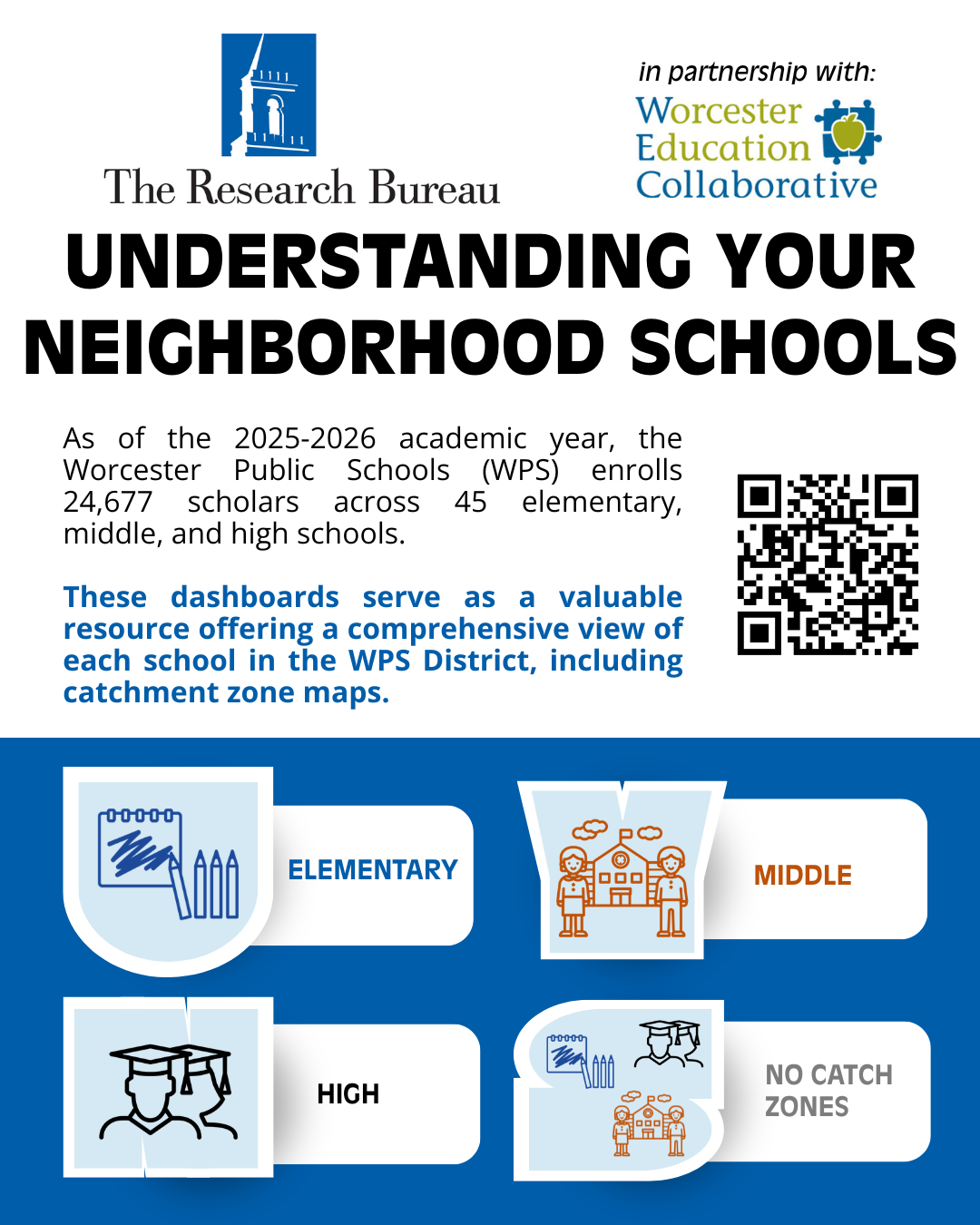
  • Understanding Your Neighborhood Schools are dashboards that serve as a valuable resource offering a comprehensive view of each school in the WPS District, including catchment zone maps.

    Thirty-three of Worcester’s Schools (including 22 non-magnet elementary schools) have catch zones where more than 50% of renter households are cost burdened.


    The 31 elementary schools with catch zones had an average 9,744 estimated residents living within them as of 2024, with an average 584 residents under 5 and 531 between 5 and 9.


    Of the 43 schools on the dashboard, 22 were rated above 100% capacity utilization in the MSBA’s 2026 school survey.

  • Mapping the Next Opportunity

    Worcester County has 49 census tracts eligible for the next round of Opportunity Zone designations including 26 in the City of Worcester.


    The next OZ map will determine which census tracts qualify for federal tax incentives from 2027 through 2036, as the 2018 designations expire at the end of 2028.


    Opportunity Zone investments have often flowed to areas already experiencing economic growth, rather than to the most distressed communities.

  • Raising Housing: Understanding the Affordable Housing Crisis in Worcester

    The report explores the severity of the affordable housing crisis facing both Massachusetts and Worcester, where rising housing costs have increasingly outpaced wages, placing sustained pressure on renters and homeowners alike.


    Forty percent of all Worcester households and half of renter households are cost-burdened.


    Housing production has not kept pace with population growth, requiring Worcester to more than double its recent annual construction rate to meet the Housing Production Plan’s target of 12,300 units by 2033.

Promoting Informed Debate and Decision-Making through Public Policy Research

The Worcester Regional Research Bureau serves the public interest of Greater Worcester by conducting independent, non-partisan research and analysis of public policy issues to promote informed public debate and decision-making. For thirty years, The Research Bureau has worked to protect the public interest in Greater Worcester by identifying issues, investigating impacts, and educating the public and government officials of opportunities and best practices.

We Appreciate Our Generous Sponsors